The Chief Editor of Sneha Sandesham is a diehard Knaist. This word does not exist; I just made it up. It has a nice ring to (it as it can be bracketed with such sophisticated words as Marxist, Capitalist, and Existentialist. I suppose we can define Knaist as someone who believes in the myths and traditions of the members of the Knanaya community. However, like the typical Kerala Marxist who in public embraces socialism but in private is a hard-line capitalist, one may be a staunch Knaist, but may have children who are only fractionally Knas since they married outside the community. We cannot blame the diehard Knaist for the ‘betrayal’ of their children.
Like all senior citizens, I do tend to wander off as I muse. It could be due to the fast depletion in brain cells as one ages. At times, I go back to Africa; at other times, I like to dabble in philosophical or educational issues. Whenever this happens, our Chief Editor, being a diehard Knaist, gently prods me back to the straight but narrow path of Knaism. Our last telephone conversation went something like this:
Chief Editor (CE): Your article on Patrick Mphephu, the black Venda king, was OK. But remember, Sneha Sandesham is a publication mainly aimed at the Knanaya community. So, Maani, see if you can discuss some Knanaya issues that can help improve the lot of our Knanaya brothers and sisters.
Maani (M): Alright. If you recall, I have mused on a number of issues pertaining to our community: the practice of endogamy, alcoholism among our members, scandalous extravagance in our marriage celebrations and perunnals, weak leadership on the side of the hierarchy, sycophantic attitude of the little lambs, feudalistic practices still prevalent among the clergy, little or no effort to look at the problems of the aged left to their own devices for survival by their non-resident children, family problems among NRIs, defence of the indefensible in the Abhaya case, etc. To keep raking up these issues repeatedly is like “flogging a dead horse”.
CE: Ha! Ha! Ha! (Peals of laughter heard on the other side of the line for a minute). Maani, I really like the expression. But I don’t think the ‘horse’ is dead; I can see some faint movement. Maybe, you should change the expression to “flogging an almost dead horse”.
M: True. In the last issue of Sneha Sandesham there was the article written anonymously by some disgruntled youth about neglect of the Malabar region by the Knanaya leadership. Going by the large number of.......... (dashes), referring I presume to rogue priests, it appeared to me to be more about the immorality among the Knanaya clergy. By ‘immorality’ I don’t mean only sexual as we, the little lambs, have been repeatedly told; it includes all the cardinal sins, starting with avarice and greed.
CE: There certainly is life in the ‘horse.’ Recently there was the shameful news of a Knanaya priest who was about to be arrested and put in jail in US for paedophilia.
M: I too heard about it. When I talked to a relative who was on a short visit home from US, he told me that the man received some inside info and left in a huff. And you know what? He is not an ordinary priest; he is a Monsignor!

CE: Well, well, well. Monsignors are a breed apart. Haven’t you heard of another Monsignor in the US who is keeping ready a bishop’s red skullcap, staff and his very own mitre with the image of Knai Thoma painted on it hoping to be made the bishop of the Knanaya diocese of USA in the near future? The man seems to be stooping to such low levels to achieve his aim that he has become an embarrassment to the Knanaya community there.
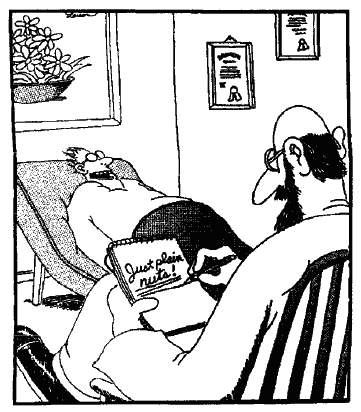
M: BTW, have you seen the email in an American Knanaya Google group wherein an appeal has been made to the Knanaya makkal in the medical profession, particularly to those in the field of psychology/psychiatry for help in treating this Monsignor to get rid of his delusions?
CE: I have. The flavour of the season among Knanaya priests in America seems to be buying/building churches.
M: This must be a big money making scam by priests. As you rightly stated in your open letter to Rev. Mutholam, the ‘Sermon on the Mount’ was delivered from a mountain top, not a gilded church pulpit. Do you know that the ‘beatitudes’ were not addressed to the world at large, but to the Qumran community who called themselves ‘poor’. It does not make sense for Jesus to ‘bless the poor in spirit,’ meaning spiritually poor, since they could not have inherited the kingdom of heaven. The inheritors were people ‘rich’ in spirit. The Sermon on the Mount is not a collection of ‘blessings,’ as taught by the Catholic Church; they should rather be viewed as a series of recruiting slogans to sign up to the Essene Sect to which, it appears, Jesus belonged.
CE: So dear Maani, we should all try to make a collective effort to get the ‘horse’ to its feet. At the moment it is full of sores lying on its stinking dung.
M: Few will contest that Knanaya belief in the ‘purity of blood’ is a myth. Can you imagine a situation wherein for more than sixteen centuries no adulteration took place? But then, one can use this myth as a unifying force. There are millions around the world who still believe in the literal creation of the universe in 7 days. My complaint is that we don’t have strong leaders either among the clergy or laity with a vision to take us forward.
CE: True. Most of the recent economic prosperity of our community members is not because of but in spite of the so called Knanaya leadership. It is the result of individual and family sacrifices. Once signs of economic success appear, the powers that be fly down with their begging mitres in the name of building churches, ‘education fund,’ and so on.
M: The current Knanaya Catholic Congress President is planning a whirlwind tour of US (I am reminded of Sancho Panza, Don Quixote’s squire) to mobilise funds for ‘endogamic’ business ventures. Following on the success of the Malabar migration, it is proposed that we encourage our people to migrate to African and South American countries where large tracts of land are available for agriculture. I am thinking of going to South America. It would be great fun to laze around on the Copacabana beaches and watch salsa dancing in the nightclubs and take part in the Brazil carnivals. Want to join?


CE: Why don’t you go first and scout the place for me. In the meantime, let me go back to flogging the dead ‘horse’.
M: The almost dead ‘horse’.
CE: Can I expect something on Knanaya issues soon?
M: Will try and get back at the earliest.
CE: Bye for now.
M: Bye and take care.